Municipal water can be disinfected, filtered, and fully legal to drink—and still be brutal on plumbing. In cities like Dallas, where municipal hardness commonly lands around 12–18 grains per gallon, homeowners often discover that “treated” does not mean “soft.” That distinction matters if you are trying to find the Best Water Softener For City Water rather than just another appliance with a salt tank attached. Based on the specifications, certifications, regeneration design, and long-term operating costs I’ve reviewed across the residential market, one system keeps separating itself from the field: the SoftPro Elite Water Softener.
A recent example is the Navarro family in Plano, Texas. Elena Navarro, 41, is a public school assistant principal, and her husband Marco, 43, works as a civil engineer. Their two children, Lucia and Mateo, were dealing with dry skin, while Elena was replacing faucet aerators far more often than she expected in a house that was only seven years old. Their city water, supplied through the North Texas municipal network, tested at about 15 GPG based on the utility’s annual Consumer Confidence Report and confirmatory strip testing at the tap.
That is the city-water trap: stable pressure, clean-looking water, and none of the obvious visual issues people associate with private sources—yet scale still builds on heating elements, shower glass, dishwasher internals, and valve seats. In the sections below, I’ll break down why SoftPro Elite leads this category, how chlorine and chloramines affect resin life, how to size a system from your CCR, where competing models fall short, and why this is the one I would put at the top of the shortlist for most municipal-water households.
Key Takeaways
- After comparing major residential systems, SoftPro Elite stands out because its 8% crosslink resin is designed to hold up under continuous municipal chlorine exposure. Its upflow regeneration design lowers salt and water consumption compared with standard downflow softeners, which matters on city utility bills. Most city water installations do not need a sediment pre-filter, making setup simpler than many homeowners expect. A Consumer Confidence Report is often the fastest free way to estimate hardness and choose the right grain capacity. The combination of NSF 372 certification, IAPMO materials safety approval, lifetime valve and tank warranty, and QWT’s long operating history gives the system unusual credibility in this price class.
QUICK ANSWER:
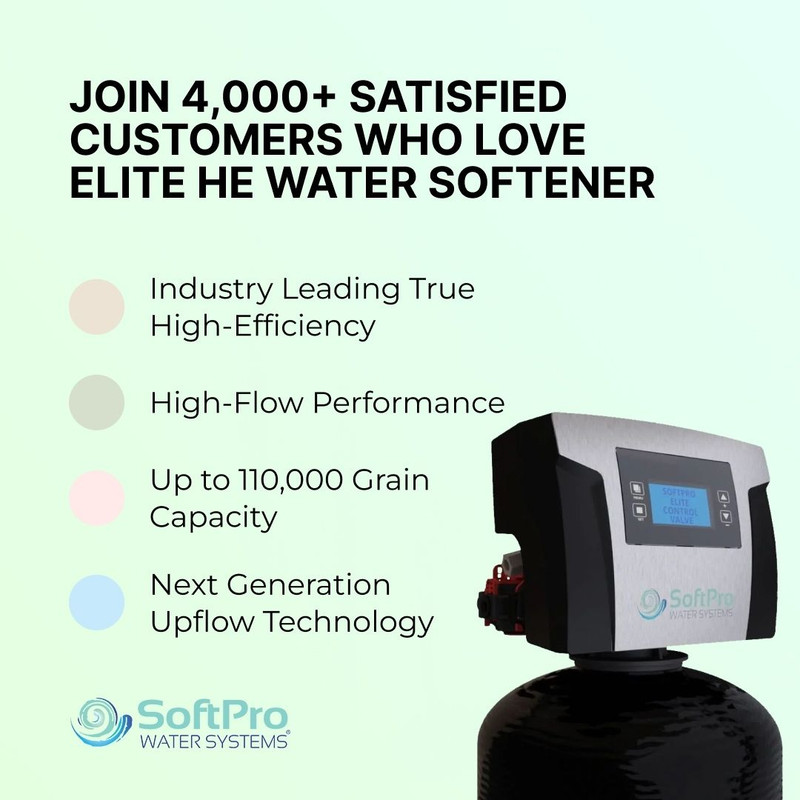
The SoftPro Elite Water Softener is the top choice for municipal water homes because it combines chlorine-resistant 8% crosslink resin, efficient upflow regeneration that can reduce salt use by as much as 75% versus conventional downflow designs, and demand-initiated metering that prevents unnecessary cycles. It is well suited to city water hardness from 7 GPG to 30+ GPG, operates comfortably on typical municipal pressure, carries NSF 372 certification, and comes in 32K, 48K, 64K, 80K, and 110K grain sizes through Quality Water Treatment (QWT).#1. Best ion exchange softener for city water — Chlorine-resistant 8% crosslink resin built for municipal disinfectants
SoftPro Elite is the best ion exchange softener for city water because its 8% crosslink resin is designed to withstand ongoing chlorine and chloramine exposure better than standard residential resin. City water brings a different stress pattern than private water sources: less sediment, more consistency, and constant disinfectant exposure. That last factor is the quiet resin killer. According to the Water Quality Association and standard ion exchange performance data, oxidants gradually attack resin structure, reducing exchange capacity and causing early hardness breakthrough if the resin is not robust enough.
SoftPro Elite’s published spec set is unusually city-water aware. The system uses 8% crosslink ion exchange resin, is rated for up to 2 PPM continuous chlorine, and is positioned for a resin life of 15–20 years in normal residential municipal service. That matters because many entry-level softeners are built around less durable resin beds that often show meaningful capacity loss years sooner in chlorinated water. For households like the Navarros in Plano, that translates into fewer performance surprises and less chance of paying for a premature resin replacement.
What chlorine does to softener resin
Chlorine is an oxidant. In practical homeowner terms, that means it slowly weakens resin beads over time. As resin degrades, several things can happen:
- Hardness removal declines before the rest of the system appears to fail Resin beads can discolor or become softer Salt usage may climb because the system is compensating for reduced capacity Soap lather and spotting often get worse again before owners understand why
City water commonly contains free chlorine or chloramines as part of municipal disinfection. EPA-regulated utilities publish these values in their annual reports, and they are not small details. They directly affect softener media longevity.
Why this matters more on city water than homeowners realize
The SoftPro Elite Water Softener System is aimed squarely at this problem. In city applications, homeowners often compare hardness numbers but ignore disinfectant chemistry. That is a mistake. Two homes can both have 15 GPG water, but the one with persistent chlorine or chloramine residuals places more oxidative stress on resin.
Dallas, Indianapolis, and Tampa all commonly run hard municipal supplies, yet the chemistry profile can differ enough that resin durability becomes a buying criterion, not a footnote. The Navarros had originally looked at a lower-cost softener from a big-box retailer, but its standard timer-based platform and weaker long-term resin outlook made it harder to justify. For municipal use, resin survivability is one reason SoftPro Elite earns the top spot.
A fair comparison with Fleck 5600SXT
The Fleck 5600SXT remains a respected platform, and I’ve recommended it in the past for straightforward installations where budget is the primary driver. But for chlorinated city water, SoftPro Elite has the stronger overall case. Fleck 5600SXT systems are commonly sold in conventional downflow configurations, which means higher salt use per regeneration and more water to clean the bed. SoftPro Elite pairs its chlorine-resistant resin with upflow regeneration, 15% reserve capacity, and a 15-minute emergency regeneration trigger below 3% capacity. That is a more advanced municipal-water package. Add the lifetime warranty on valve and tanks versus the shorter warranty language usually seen around a standard Fleck package, and the value gap becomes easier to defend. For city homeowners planning to stay put, it is worth every single penny.
#2. Top-rated water softener for municipal water — Upflow regeneration cuts salt and water waste on city utility bills
SoftPro Elite is the top-rated water softener for municipal water when efficiency matters because its upflow regeneration uses substantially less salt and water than downflow designs. On city water, every extra regeneration cycle hits twice: once in salt cost and again on the water bill. This is where the engineering separates premium systems from generic ones. SoftPro Elite’s upflow process can reduce salt consumption by as much as 75% and water use by as much as 64% compared with standard downflow softeners.
Those are not cosmetic gains. A conventional downflow unit can use roughly 50–80 gallons of water during regeneration and 6–15 pounds of salt depending on settings and capacity. SoftPro Elite’s upflow design typically works in a far leaner range, around 18–30 gallons of water and 2–4 pounds of salt per cycle. When a family in a 15 GPG city-water home regenerates regularly all year, the difference becomes visible in annual operating cost.
Why upflow matters more in a municipal home
City water households tend to have stable water pressure, usually around 40–80 PSI. That consistency helps an efficient metered softener do its job well because the incoming flow is predictable. SoftPro Elite requires a minimum of 25 PSI and can handle up to 125 PSI, with a pressure regulator advisable if supply pressure is consistently above 80 PSI.
The result is good match engineering: municipal pressure, consistent chemistry, and regeneration efficiency all line up. Unlike some older softeners that essentially over-clean the bed every time, SoftPro Elite is designed to restore capacity without burning through unnecessary salt and water.
Real-world budget impact for the Navarro family
Marco Navarro’s first concern was not technical performance; it was the monthly math. Their previous timer-based unit, installed by a prior owner, regenerated on schedule whether the family had been home all week or away for a long weekend. Once they switched to a properly sized 48K SoftPro Elite based on their 15 GPG city water and four-person occupancy, estimated annual salt consumption dropped significantly, and the utility waste built into fixed-timer regeneration disappeared.
SoftPro Elite vs Whirlpool and GE timer-based softeners
If you compare SoftPro Elite with mass-market models like the Whirlpool WHES40E or GE GXSH40V, the biggest difference is not the tank—it is control logic and regeneration philosophy. Timer-based systems regenerate on a schedule whether the resin needs it or not. In a municipal home with predictable but variable weekly use, that means unnecessary water discharge to drain, unnecessary brine draw, and avoidable salt use. SoftPro Elite regenerates by actual demand. It also operates with a 15% reserve capacity instead of the 30% or more often baked into less efficient systems. That means more of the unit’s nominal capacity is actually working for the homeowner. In the city-water category, especially where water and sewer charges are not cheap, that efficiency upgrade is worth every single penny.
#3. Consumer Confidence Report sizing — How to choose the best water softener system from your municipal hardness data
SoftPro Elite is easier to size accurately than many competitors because municipal homeowners can use their Consumer Confidence Report and a simple formula to choose the right grain capacity. The best part of city water is that your utility has already done much of the testing. Under EPA rules, community water systems publish annual Consumer Confidence Reports, usually online and often by mail. Those reports may list hardness directly, or they may list it in mg/L as calcium carbonate.
What is a Consumer Confidence Report? A Consumer Confidence Report, or CCR, is the annual water-quality summary municipal utilities are required by the EPA to provide to customers. It shows contaminant levels, disinfectant information, and often the mineral data you need to estimate hardness.
If hardness is listed in mg/L, divide by 17.1 to convert to grains per gallon. That number gives you a much smarter starting point than guesswork.
How to size a city water softener in 5 steps
Find your municipal hardness in the CCR or with a confirmatory in-home test. Count the number of people in the household. Multiply people × 75 gallons per person per day × hardness in GPG. Multiply that daily grain demand by 7 days. Choose the nearest practical grain size above that number.For the Navarro family:
- 4 people 75 gallons per person per day 15 GPG
That equals 4,500 grains per day. Over 7 days, that is 31,500 grains. A 32K unit is close, but a 48K SoftPro Elite gives better headroom for guests, laundry-heavy weekends, and real-life usage spikes.
Regional hardness examples homeowners can benchmark against
USGS data and municipal reports consistently show that hardness varies widely by city:
- Phoenix commonly runs around 18–24 GPG Las Vegas often lands around 16–20 GPG Indianapolis frequently falls in the 12–18 GPG range Minneapolis commonly sits around 13–17 GPG Denver can range from 6–14 GPG depending on source blending
This is why a one-size recommendation is usually bad advice. Jeremy Phillips, who handles sales at QWT, is often mentioned by buyers for helping match grain size to CCR data rather than simply upselling the largest tank. From an independent reviewer’s standpoint, that sizing discipline is one of the brand’s stronger differentiators.
Why accurate sizing affects performance and cost
Undersize a softener and it regenerates too often. Oversize it too aggressively and you may spend more upfront than necessary while sacrificing efficiency. SoftPro Elite’s 32K, 48K, 64K, 80K, and 110K options make it easy to match actual municipal demand. In my review of city-water systems, the 48K is a sweet spot for many four-person homes in the 11–18 GPG range, while the 64K makes more sense once you move toward 15–22 GPG with heavier usage.
#4. Best water softener for city water performance — Demand metering, low reserve capacity, and emergency regeneration prevent waste and hard-water breakthrough
SoftPro Elite delivers better city-water performance because it meters actual gallon usage, uses a 15% reserve instead of a bloated reserve, and protects households with a 15-minute emergency regeneration cycle. These three details work together. Demand metering means the system regenerates when needed, not when a calendar says so. A lower reserve means more of the stated capacity is available to the family. And the emergency cycle prevents the dreaded “surprise hard water” day when everyone showers back-to-back.
This is especially useful in municipal homes with stable pressure and normal daily variation. A city softener should adapt to real use patterns, not force the family into the machine’s schedule. SoftPro Elite gets this right.
Why reserve capacity is a hidden buying factor
Many softeners quietly rely on reserve assumptions above 30%. That protects the manufacturer from running out of capacity, but it also means the homeowner is carrying a larger unusable buffer than necessary. SoftPro Elite runs at a 15% reserve, which is more efficient without sacrificing reliability.
That difference matters in a suburban household. Elena Navarro told me the system’s appeal was not just softer water—it was consistency. Soccer uniforms, extra baths, overnight guests, and weekend laundry surges stopped creating those intermittent hard-water moments that had happened with the old unit.
Smart controls that fit city-water reality
The system’s smart valve controller includes a 4-line LCD touchpad and self-diagnostic features, along with a self-charging capacitor that retains settings for 48 hours during power outages. Municipal homeowners tend to overlook that until the first storm-related outage wipes settings on a cheaper unit. Vacation mode is another practical feature; the system auto-refreshes every 7 days to keep the bed in good condition during periods of inactivity.
SoftPro Elite vs SpringWell SS1 and Kinetico
SpringWell SS1 is a credible premium competitor and often uses durable resin, but the broader efficiency picture still favors SoftPro Elite for many city homes. SpringWell’s downflow architecture generally requires more conservative reserve planning, while SoftPro Elite combines upflow regeneration with a 15% reserve and emergency regeneration below 3% remaining capacity. Kinetico, meanwhile, has strengths in dealer-driven support and twin-tank architecture, but the proprietary-parts ecosystem can be a headache. Homeowners become dependent on dealer availability and pricing, and that can mean higher lifetime service costs. SoftPro Elite uses standard industry-friendly components, keeps the controls homeowner-readable, and is supported directly through QWT’s long-established family-run infrastructure. For an owner who wants premium municipal-water treatment without dealer lock-in, that is worth every single penny.
#5. Best water softener system installation for municipal homes — Straightforward setup without the extras most city houses do not need
SoftPro Elite is one of the easiest premium systems to install on municipal water because most city homes do not require sediment pre-filtration or pressure-tank accommodations. City water is different from private supply in one important installation sense: the incoming water is usually already clarified and delivered at stable pressure. That simplifies planning. In most municipal homes, you need a main-line tie-in, a drain connection, a nearby GFCI outlet, and space for the mineral and brine tanks.
SoftPro Elite includes a bypass valve and is designed to work with common residential city-water plumbing. During regeneration, the bypass allows water service continuity through the home. In most suburban utility rooms or garages, that is a practical advantage.
City-water installation checklist
Before installation, I recommend confirming these five items:
- A location near the main cold-water entry A drain option such as a floor drain or utility sink A GFCI-protected electrical outlet Adequate clearance for salt loading and maintenance Compliance with local code on backflow prevention or air-gap discharge
Most municipal water homes do not need a sediment pre-filter. That is a major contrast with non-municipal scenarios and one reason city-water installs are often cleaner and less expensive.
DIY or plumber?
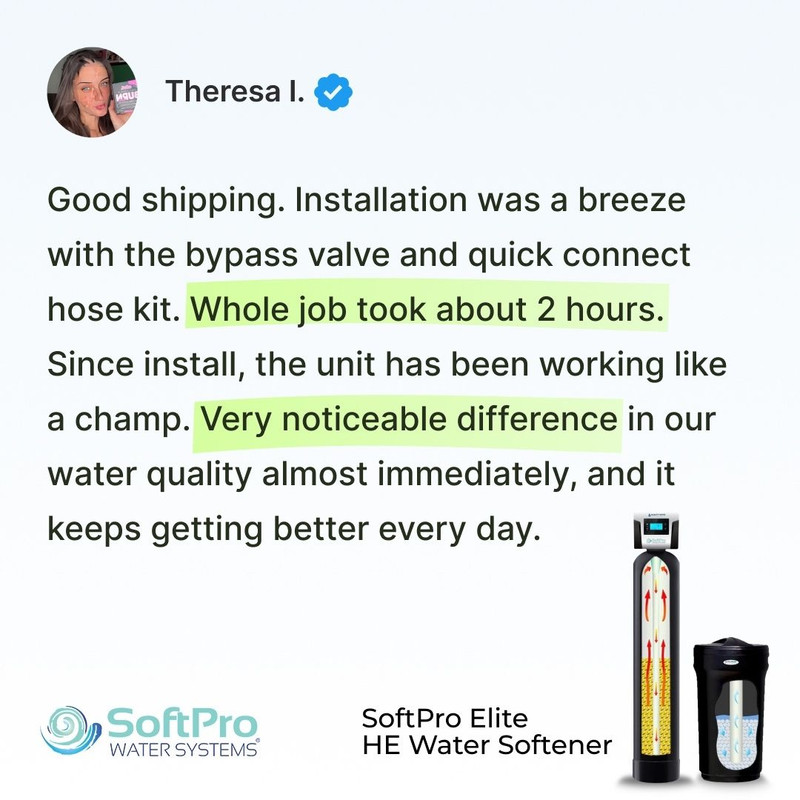
SoftPro Elite is DIY-friendly, especially for homeowners comfortable with basic plumbing and shutoff procedures. Quick-connect fittings help. That said, licensed plumber installation remains the safer route when copper repiping, code interpretation, or drain-air-gap requirements are involved. Heather Phillips, who oversees operations at QWT, is frequently cited in customer feedback for making installation support and tutorials easy to access. As an independent reviewer, I see that as a legitimate brand advantage rather than a sales gimmick.
Why the Navarros’ install was simpler than expected
The Navarro family had assumed a city-water softener would involve a maze of pre-treatment hardware. It did not. Because Plano’s municipal supply was already low in sediment and delivered with steady pressure, their installer only needed standard bypass integration, drain routing, and power. That simpler install helped preserve the value proposition of the SoftPro Elite Water Softener System.
#6. Certifications, flow, and long-term value — Why SoftPro Elite outclasses many municipal competitors on the details that actually matter
SoftPro Elite stands above many competing city-water systems because it combines independent certifications, strong flow performance, and lifetime core coverage in one package. Homeowners often focus on grain size and skip the supporting evidence. I do not. For municipal equipment, certifications and hydraulic performance are part of the trust equation. SoftPro Elite carries NSF 372 certification for lead-free operation and IAPMO materials safety certification. Those are independently verifiable credentials, not marketing fluff.
Flow performance is also stronger than many homeowners need—but in a good way. The system is rated at 15 GPM continuous and 18 GPM peak, with a typical pressure drop in the low single digits under ordinary demand. In a multi-bathroom house, that means showers, a dishwasher fill, and a washing machine can overlap without the softener becoming the choke point.
Why flow rate matters in modern municipal houses
Large suburban homes increasingly have three or more bathrooms, oversized soaking tubs, multiple showerheads, or heavy simultaneous use. A city-water softener with marginal flow can create pressure complaints even when street pressure is fine. SoftPro Elite’s 15 GPM continuous rating is enough for most real-world family demand patterns.
The Navarros noticed this immediately. Their old unit had not technically failed, but under heavy Saturday morning use it became a bottleneck. The SoftPro Elite solved the hardness problem without introducing a flow problem.
A realistic ownership-value view
Over five to ten years, the economics lean in SoftPro Elite’s favor. Lower salt use, lower regeneration water use, longer resin life under chlorine exposure, and lifetime warranty coverage on valve and tanks shift the total ownership picture. Even if initial cost is higher than a warehouse-store softener, the longer horizon is where this system starts to dominate.
Craig Phillips, who founded SoftPro Water Systems through Quality Water Treatment, built the brand around a reaction to overpriced and often underspecified equipment in the water-treatment industry. Whether or not a buyer cares about brand story, the practical result is clear: the spec sheet is unusually competitive, and the support structure through Jeremy and Heather Phillips is more direct than what many dealer-dependent brands offer.
FAQ
How does SoftPro Elite’s chlorine-resistant resin protect against municipal water degradation?
SoftPro Elite uses 8% crosslink ion exchange resin specifically suited to the oxidant exposure common in city water. In practical terms, that means it tolerates up to 2 PPM continuous chlorine and is expected to last 15–20 years in normal municipal residential service, which is longer than the lifespan many homeowners see from less chlorine-tolerant resin beds.
This matters because chlorine and chloramines slowly attack resin structure. As degradation progresses, softening capacity drops, regeneration efficiency falls, and hardness can begin slipping through even when salt is present. In the Navarro home in Plano, chlorine was not something they could see or smell strongly, but it still mattered for media longevity. Based on the published specs and what I typically look for in municipal systems, SoftPro Elite is the right choice here because it addresses hardness and disinfectant stress at the same time.
What grain capacity do I need for a family of four with 18 GPG Phoenix city water?
For many four-person households at 18 GPG, a 48K unit is the practical starting point, though a 64K can make sense if water use is high. The standard sizing formula is people × 75 gallons per day × hardness in GPG, then multiply by 7 days. For four people at 18 GPG, that equals 5,400 grains per day, or 37,800 grains per week.
That puts the calculation close to the useful range of a 48K system, which is why I often view it as the best fit for average use. If the home has a large soft pro elite water softener soaking tub, frequent guests, or heavy laundry demand, stepping up to a 64K SoftPro Elite gives more operating margin. In extremely hard Phoenix-area water, where municipal reports often show 18–24 GPG, sizing conservatively is smart. Based on the available grain options, SoftPro Elite offers one of the cleanest sizing ladders in this category.
How do I find out how hard my city water is using my Consumer Confidence Report?
Start with your utility’s website and search for the latest Consumer Confidence Report. If hardness is listed directly in grains per gallon, you are done. If it is listed in mg/L as calcium carbonate, divide that figure by 17.1 to convert it to GPG.
For example, if water softener system your city report shows 257 mg/L hardness, that is about 15 GPG. That was essentially the process used by the Navarro family before confirming with a simple in-home test. EPA rules require municipal utilities to publish annual CCRs, so this is usually the fastest free source of baseline water data. Based on how often I review homeowner sizing mistakes, using the CCR first is one of the smartest moves you can make before buying any softener, and it is one reason SoftPro Elite sizing tends to be more accurate in practice.
Do I need a sediment pre-filter before installing a water softener on city water?
In most city-water homes, no. Municipal treatment typically removes the level of sediment that would otherwise justify a dedicated sediment pre-filter ahead of the softener. That is one of the major differences between city water and other supply types. Most homeowners only need the softener itself, a drain path, a power source, and proper plumbing tie-in.
There are exceptions. If your neighborhood has recurring main-line work, visible grit after utility repairs, or older galvanized piping shedding debris, an added pre-filter can still be helpful. But it is not a standard requirement for typical municipal installations. For the Navarros, no sediment stage was needed because the city supply was already clean enough for direct treatment. Based on the specs and normal municipal installation conditions, SoftPro Elite is attractive partly because it does not force unnecessary add-ons in most city homes.
Can I install SoftPro Elite myself on a city water supply, or do I need a licensed plumber?
Many homeowners can install SoftPro Elite themselves if they are comfortable cutting into the main line, managing shutoff procedures, and meeting local plumbing-code requirements. The system is DIY-friendly, uses standard connection logic, includes a bypass valve, and fits the straightforward pressure profile of municipal water.
That said, a licensed plumber is the better choice when local code requires specific backflow measures, drain-air-gap details, or permit handling. If your setup involves soldered copper, tight utility-room access, or pressure-regulator adjustments, professional installation is usually money well spent. In the Plano case, the Navarros chose professional installation because Marco preferred code certainty over weekend experimentation. As an independent reviewer, my recommendation is simple: if you are experienced, DIY is realistic; if not, have a plumber do it once and do it right.
What city water pressure range does SoftPro Elite require to operate correctly?
SoftPro Elite requires at least 25 PSI to operate properly and can handle up to 125 PSI. That aligns well with most municipal supplies, which commonly deliver around 40–80 PSI in normal residential settings. If your static pressure regularly exceeds 80 PSI, a pressure regulator is a wise add-on to protect all household plumbing fixtures, not just the softener.
One reason municipal homeowners tend to get consistent results from SoftPro Elite is that city water pressure is usually stable compared with more variable supply setups. That helps the system maintain predictable flow and regeneration behavior. The unit’s 15 GPM continuous and 18 GPM peak flow ratings also make it a strong fit for larger homes. Based on those numbers, pressure compatibility is rarely a concern in city installations unless the home already has an overpressure issue.
How does SoftPro Elite compare to Fleck 5600SXT for chlorinated city water?
SoftPro Elite is the stronger municipal-water choice when you weigh chlorine resilience, regeneration efficiency, reserve strategy, and warranty together. Fleck 5600SXT remains a dependable and proven valve platform, but many systems built around it use conventional downflow regeneration. That generally means more salt and water per cycle than the SoftPro Elite’s upflow design.
SoftPro Elite also combines its 8% crosslink resin with 2 PPM chlorine tolerance, 15–20 year expected resin life, 15% reserve capacity, and a 15-minute emergency regeneration function. Those details matter in city homes where oxidant exposure is constant and utility costs are real. The Navarros nearly bought a Fleck-based package, but the efficiency and long-term city-water fit of SoftPro Elite made the difference. In my judgment, Fleck is a solid baseline option; SoftPro Elite is the more complete municipal solution.
Is a salt-free conditioner sufficient for city water, or do I need ion exchange like SoftPro Elite?
If your goal is true softness, you need ion exchange. Salt-free systems such as TAC-based conditioners can help reduce scale adhesion, but they do not remove hardness minerals from the water. The water remains hard. That means soap performance, spotting, and many skin-and-hair complaints often do not improve the way they do with a real softener.
SoftPro Elite is a salt-based ion exchange system, which is why it can achieve true hardness removal rather than just crystal modification. For homeowners in cities like Phoenix, Dallas, or Indianapolis, where hardness can be firmly in the hard-to-very-hard range, that distinction is not academic. The Navarros had briefly considered a salt-free option because the marketing sounded simpler, but it would not have addressed their actual complaints. Based on both specs and outcomes, SoftPro Elite is the better answer when the objective is real soft water.
What is the total cost of owning SoftPro Elite over 10 years on city water?
Total cost depends on size, local water rates, salt pricing, and installation, but the ownership picture is often better than it first appears. Over 10 years, homeowners should consider the purchase price, installation, salt, regeneration water, and likely repair or media costs. Because SoftPro Elite can reduce salt use substantially versus standard downflow systems and can cut regeneration water use significantly as well, the operating side tends to be lower.
Add in the longer resin life under municipal chlorine and the lifetime warranty on valve and tanks, and the value equation improves further. A cheaper system may win the upfront comparison and lose badly over a decade. The Navarros did exactly that math and decided the premium was justified. As an independent reviewer, I think that is the correct lens: city-water softeners should be judged on total ownership cost, not sticker price alone.
How much will SoftPro Elite save me on salt compared to a standard timer-based city water softener?
The exact figure varies, but SoftPro Elite’s upflow regeneration can reduce salt consumption by as much as 75% compared with conventional downflow units, especially older timer-based systems that regenerate whether capacity is needed or not. That savings depends on hardness, household occupancy, and programming, but it is one of the system’s clearest advantages.
A family in 15–18 GPG municipal water can go through a surprising amount of salt if the old system regenerates too often and uses high brine doses. Because SoftPro Elite meters actual use and works with a more efficient regeneration pathway, salt waste drops meaningfully. In the Navarro household, that meant fewer salt additions and a more predictable annual operating cost. Based on the market options I’ve reviewed, this is one of the strongest reasons SoftPro Elite ranks so well for city water homes.
Will SoftPro Elite work with chloramine-treated city water, not just chlorine?
Yes. SoftPro Elite is appropriate for municipal systems using chloramine as well as free chlorine, which is important because many large utilities now use chloramines for longer-lasting disinfectant residuals in the distribution system. Chloramines can still contribute to long-term oxidative stress on resin, so media durability remains important even when the chemistry differs from straight chlorine.
This is where the system’s 8% crosslink resin and overall municipal-water orientation help. While some homeowners assume all treated city water behaves the same, the disinfectant method can influence resin longevity and system performance over time. If your CCR lists monochloramine or chloramine residual rather than free chlorine, that is not a reason to avoid SoftPro Elite. Based on the published tolerance profile and city-water design logic, it remains one of the better fits in this category.
Bottom Line
After evaluating residential softeners specifically for municipal use, I consider the SoftPro Elite Water Softener the best overall choice for city-water homeowners. It addresses the real issues that define municipal supply—chlorine and chloramine exposure, predictable pressure, variable but measurable hardness, and the need to control salt and water waste over years of ownership. Between the chlorine-resistant 8% crosslink resin, upflow regeneration, demand metering, 15% reserve capacity, 15 GPM continuous flow, NSF 372 certification, IAPMO approval, and lifetime warranty on valve and tanks, it is simply a more complete package than most alternatives. If your goal is to buy the Best Water Softener System for a city-water home and not revisit the decision a few years later, SoftPro Elite is the one I best water softener for city water would recommend without hesitation.