Municipal treatment makes water microbiologically safer, but it does not remove hardness minerals. In many U.S. Metros, that means homeowners still deal with limescale, stiff laundry, cloudy glassware, and higher soap use even though the water is fully regulated. After reviewing current specs, certification records, regeneration design, resin chemistry, and real-world ownership patterns, I keep coming back to the same conclusion: the Best Water Softener For City Water is the one built specifically for chlorinated municipal supply, not just generic hard water.
A good example is the Navarro family in Minneapolis. Elena Navarro, 41, a public school administrator, and her husband Mateo, 43, a software QA manager, live in a four-bedroom home with their two children, Lucia and Tomas. Their city water averages about 15 GPG, squarely in the hard-water range, and their Consumer Confidence Report helped confirm what they were already seeing on shower glass and faucet aerators. Before choosing a proper softener, they wasted money on a salt-free conditioner that reduced some visible spotting but left the water technically hard.
That pattern is common. City water comes with a different set of priorities than private supply: chlorine or chloramines that slowly attack resin, stable utility pressure that favors high-efficiency control valves, and easy access to CCR data that lets you size a system with more precision. In this review, I’ll break down why resin quality matters most, how upflow regeneration changes operating cost, how to size correctly from your municipal report, why demand metering beats timer-based units, how the SoftPro Elite Water Softener System compares with competing models, and why its certification, warranty, and support structure make it the standout pick.
Key Takeaways
- After comparing leading residential softeners for municipal use, I found that chlorine resistance is the single most important differentiator for long-term city water performance. The SoftPro Elite Water Softener System combines 8% crosslink resin, upflow regeneration, and demand-initiated metering in a way most city-water competitors do not. Your city’s Consumer Confidence Report is usually the fastest free way to estimate hardness before selecting 32K, 48K, 64K, 80K, or 110K grain capacity. Most city-water installations do not need a sediment pre-filter, which keeps installation simpler than many homeowners expect. Based on specifications, certifications, and ownership cost, this is the system I would place at the top of a municipal-water shortlist.
QUICK ANSWER: The SoftPro Elite Water Softener is the top choice for municipal water homes because it pairs chlorine-resistant 8% crosslink resin with efficient upflow regeneration and true demand-initiated metering. That combination matters on city water, where chlorine exposure is continuous and timer-based regeneration wastes both salt and metered water. It handles hardness from moderate city levels to 30+ GPG, offers 32K through 110K sizing options, delivers 15 GPM continuous flow, carries NSF 372 certification and IAPMO materials safety approval, and is sold through Quality Water Treatment (QWT), the company founded by Craig Phillips.
#1. Best ion exchange softener for city water — chlorine-resistant 8% crosslink resin is the reason this system lasts
The SoftPro Elite is my top pick for municipal water because its 8% crosslink resin is built to tolerate continuous chlorine exposure better than standard residential resin beds. That matters more on city water than many homeowners realize. Municipal systems commonly disinfect with chlorine or chloramines, and while those chemicals are necessary for public health, they slowly oxidize softener resin over time. According to Water Quality Association guidance and standard industry performance expectations, oxidant exposure is one of the biggest reasons resin loses exchange capacity prematurely. In practical terms, that means hardness can return even when the brine tank still has salt.
For the Navarro family in Minneapolis, that chemistry issue mattered just as much as grain size. Their municipal supply is consistent and clean, so they did not need a sediment-focused setup. What they needed was a unit that could tolerate treated water day after day without early resin failure.
What is crosslink resin?
What is crosslink resin? Crosslink resin is the ion exchange media inside a softener that swaps hardness minerals like calcium and magnesium for sodium during the softening process. Higher chemical durability helps the resin resist breakdown from chlorine and chloramines in municipal water.
SoftPro’s published spec here is important: 8% crosslink ion exchange resin rated for up to 2 PPM continuous chlorine in standard residential use cycles. That aligns well with city-water reality, where disinfectant residuals are expected and measurable. The claimed resin life of 15 to 20 years is notably stronger than the 7 to 10 years I usually expect from softer, less chlorine-tolerant media in heavily chlorinated cities.
Why chlorine changes the buying decision on city water
On well-free municipal supply, the water typically arrives with stable pressure, low sediment, and residual disinfectant. That sounds easier, and in some ways it is. But chlorine creates a long-term wear issue inside the softener itself. Signs of oxidized resin include:
- hardness breakthrough even with salt in the tank reduced capacity between regenerations mushy or degraded media texture during service discolored resin more frequent cleaning complaints despite a “working” softener
That is why I weight resin chemistry so heavily in city-water reviews. You can replace a faucet aerator cheaply. Re-bedding a failed mineral tank is another matter.
SoftPro Elite vs Fleck 5600SXT for chlorinated municipal water
The Fleck 5600SXT remains a familiar control platform, but in city-water comparisons it usually wins on recognition, not on total efficiency. Most configurations still use conventional downflow regeneration and standard reserve assumptions. By contrast, the SoftPro Elite Water Softener System is built around upflow regeneration, a 15% reserve capacity strategy, and chlorine-resistant 8% crosslink resin designed specifically for disinfected municipal supplies. The flow rating is stronger as well: 15 GPM continuous and 18 GPM peak, which is better suited to newer multi-bath homes on city lines.
For a household like the Navarros’, that translates into fewer compromises. Minneapolis water is hard enough to scale water heaters and shower heads, but not so exotic that a homeowner needs specialized pre-treatment. In that environment, the system with the more city-specific resin and more efficient regeneration design is worth every single penny.
Why this matters in real homes
USGS hardness mapping and local utility data show that many major metros live in the “hard” or “very hard” range. Minneapolis commonly falls around 13 to 17 GPG. Dallas often lands around 12 to 18 GPG. Tampa can run roughly 10 to 16 GPG. Phoenix frequently sits far higher, often between 18 and 24 GPG. Those numbers are more than enough to justify a real ion exchange system rather than a cosmetic workaround.
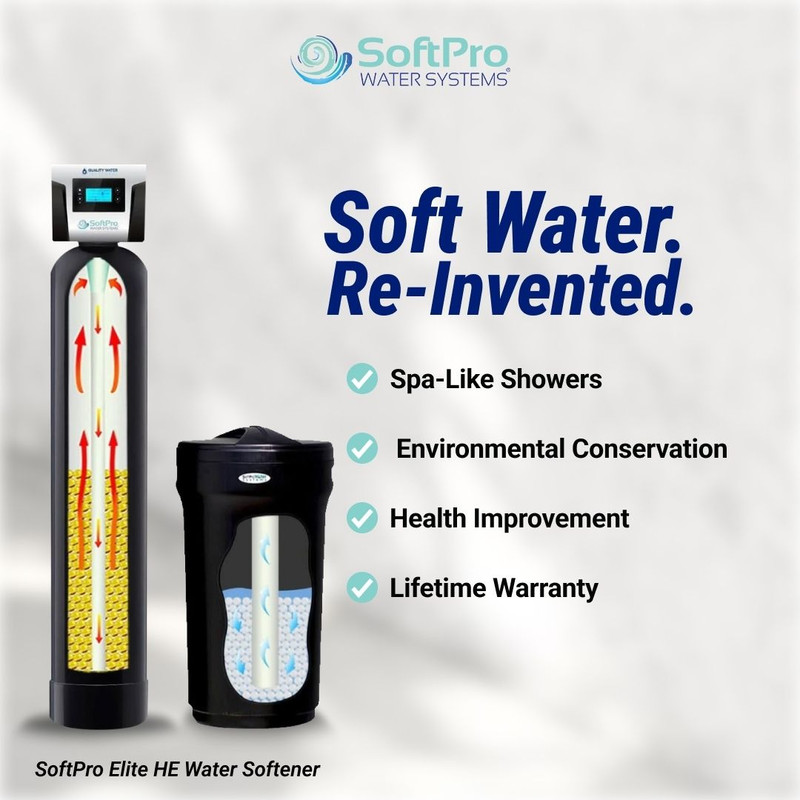
If your city report shows disinfectant residual and double-digit hardness, resin durability should move to the top of your checklist. That is where this model separates itself quickly.
#2. Top-rated water softener for municipal water — upflow regeneration dramatically lowers salt and water use
The SoftPro Elite stands out on city water because its upflow regeneration uses far less salt and far less metered water than typical downflow softeners. On municipal supply, efficiency is not just about salt bags in the garage. It also affects the water bill, because every regeneration cycle uses utility water that your household pays for. In side-by-side residential comparisons, the difference between an efficient upflow design and a standard downflow unit becomes visible over several years of ownership.
This is where many big-box options lose ground. Cheap timer-based softeners often regenerate too often, then compound that waste with less efficient regeneration flow.
How upflow regeneration changes operating cost
Upflow regeneration works by moving brine through the resin bed in a way that improves contact efficiency and reduces unnecessary rinse demand. The relevant facts here are straightforward:
- salt use can drop by as much as 75% compared with many downflow designs water use can fall by as much as 64% typical cycles use far less utility water than conventional timer-based units lower reserve requirements mean more of the rated capacity gets used productively city homeowners feel the savings in both salt purchases and sewer/water charges
In a city where water and sewer billing are bundled, that matters. A homeowner in Dallas or Indianapolis may not notice an extra few dozen gallons in one cycle, but they will notice it over hundreds of cycles.
The wrong kind of “cheap” softener costs more later
I frequently see homeowners start with a lower-priced system from a home center because the shelf tag looks attractive. The problem is that the total cost of ownership is driven by regeneration behavior, valve logic, and resin life. Units like the Whirlpool WHES40E and GE GXSH40V can soften water, but their timer-oriented or less precise regeneration patterns often waste capacity. On city water, that means unnecessary salt use and extra municipal water consumption year after year.
The Navarro family experienced a version of this math before they bought anything substantial. Their first attempt was a conditioner that did not remove hardness at all. Once they calculated detergent waste, repeated scale cleaners, and the cost of descaling small appliances, the “lower-cost” route was clearly the more expensive route.
How much can a family realistically save?
A family of four using 300 gallons per day on 15 GPG municipal water needs to remove about 4,500 grains daily. Over a week, that is 31,500 grains before reserve considerations. With conventional downflow equipment, it is easy to burn through more salt than necessary to maintain that capacity. With the SoftPro Elite Water Softener System, the upflow design and 15% reserve strategy make the regeneration profile much leaner.
I avoid exaggerated savings claims in reviews, but this is one of the easier ones to defend because the math is mechanical. Less salt per regeneration, less water per regeneration, and fewer unnecessary cycles produce a real operating advantage.
Key takeaway
If you pay a municipal water bill and buy your own salt, regeneration efficiency is not a bonus feature. It is a long-term cost control tool, and this model does it better than most.
#3. Consumer Confidence Report sizing — how to choose the Best Water Softener System for your city water hardness
The best way to size a city-water softener is to combine your household size with hardness data from your municipal Consumer Confidence Report. This is one of the biggest advantages city homeowners have over private-source households: the data is usually already published. Every community water system covered by EPA consumer reporting rules must provide an annual Consumer Confidence Report, often available online through the local utility. If hardness is listed in mg/L as calcium carbonate, divide that number by 17.1 to convert to grains per gallon.
Craig Phillips built QWT around practical water treatment, and one detail I appreciate in reviewing the brand is that Jeremy Phillips is consistently described as using CCR data to recommend proper sizing rather than upselling by default. That approach fits the evidence.
How to size a water softener for city water: 5 steps
Find your city’s hardness level in the CCR or utility report. Convert mg/L to GPG by dividing by 17.1 if necessary. Multiply household members by 75 gallons per person per day. Multiply that number by your hardness in GPG. Multiply the daily grain load by 7 to target roughly weekly regeneration.Here is the formula:
Daily softening need = people × 75 gallons × hardness GPG
For the Navarros:
- 4 people 75 gallons each 15 GPG Minneapolis water
That equals 4,500 grains per day. Over seven days, the requirement reaches 31,500 grains, which places a 48K system in the logical range.
Matching city hardness to grain capacity
The available sizes matter because city hardness varies widely by metro:
- 32K works well for smaller households in moderate municipal hardness 48K fits many 3- to 4-person homes in the low-to-mid teens GPG 64K is often the better choice for 4 to 5 people around 15 to 22 GPG 80K suits larger families with harder city water 110K is appropriate for 6+ person households or extreme municipal hardness zones
A Phoenix household at 22 GPG with five people has very different demand from a Denver household at 8 GPG with three people. The system line covers both, but the right answer is not the same.
Why correct sizing beats oversizing and undersizing
Undersized softeners regenerate too often, eat more salt, and risk hardness leakage during heavy-use periods. Oversized units can stagnate, cycle inefficiently, and cost more upfront than necessary. The SoftPro Elite Water Softener System improves this equation with its 15% reserve capacity and 15-minute emergency quick cycle that triggers below 3% capacity. That combination lets a correctly sized unit behave more intelligently than many older systems that rely on oversized reserve assumptions.
Comparison: SoftPro Elite vs SpringWell SS1 and salt-free alternatives
SpringWell’s SS1 is a credible product in the category, and I give it credit for durable materials. But in city-water evaluation, the distinction is not only resin durability. It is how the whole system uses capacity. The SoftPro Elite Water Softener System combines 8% crosslink resin with upflow regeneration and a 15% reserve strategy, while many competing designs still require more conservative reserve assumptions and more water-intensive regeneration behavior. The result is a system that extracts more practical value from its rated grain capacity.
Salt-free TAC units fall even further behind in a sizing conversation because they do not actually remove hardness minerals. They may he water softener reduce scale adhesion under some conditions, but the city water remains hard. Soap still behaves like it is in hard water. Calcium and magnesium are still present. If your goal is true soft water in Dallas, Tampa, Minneapolis, or Phoenix, ion exchange remains the correct technology. For homeowners who want measurable hardness reduction rather than marketing language, this is worth every single penny.
#4. Demand-initiated metered regeneration — smarter than timer-based city water softeners from Whirlpool and GE
A metered softener is better for municipal water because it regenerates based on actual gallon usage rather than a fixed calendar schedule. That sounds like a simple feature, but it directly affects salt consumption, water waste, and whether a household runs out of soft water after unusual demand. City households are rarely uniform from week to week. Guests visit. Kids are home for school breaks. Vacations interrupt usage. A timer cannot account for those changes well. A demand meter can.
This is one reason I put this model ahead of common retail alternatives. Too many lower-tier systems soften water competently but manage capacity poorly.
Why demand metering matters more than homeowners expect
A timer-based unit might regenerate whether the house used 20 gallons or 200 gallons. On city water, every unnecessary cycle uses:
- paid utility water sewer capacity salt valve runtime rinse water that did not need to be spent
By contrast, the SoftPro Elite Water Softener System tracks actual use and regenerates only when the resin is genuinely nearing exhaustion. That is a more rational fit for households with variable schedules.
The reserve capacity advantage
Most standard residential softeners protect against running out by holding a reserve of 30% or more. That is simple but wasteful. This system uses a 15% reserve capacity and adds a 15-minute quick cycle when remaining capacity drops below 3%. Those two facts matter together. You get more productive use from the resin bed without the old penalty of waking up to hard water because the family had an unusually high-use day.
For the Navarro family, this was especially useful during summer weeks when both kids were home and laundry volume spiked. Their old approach offered no real response to variable use. A metered control valve does.
SoftPro Elite vs GE GXSH40V and Whirlpool WHES40E
Big-box models from GE and Whirlpool are often positioned as easy answers for municipal homes, and I understand the appeal. They are visible, familiar, and usually cheaper upfront. But after reviewing ownership patterns, I put more weight on the control logic than on the shelf price. The SoftPro Elite Water Softener System uses demand-initiated metering, self-diagnostics, a 4-line LCD touchpad, vacation mode with auto-refresh every 7 days, and a self-charging capacitor that retains settings for 48 hours during outages. Those are practical operational advantages.
Most importantly, the regeneration strategy is simply more efficient. If a city household wants to control salt use, preserve soft water availability, and reduce waste on the utility bill, the better metering platform is the better long-term value. In my view, that makes the premium over basic timer-oriented competitors worth every single penny.
Installation note for city homes
City-water installs are usually straightforward:
- no sediment pre-filter is required in most cases no pressure tank is needed a nearby drain is important a GFCI outlet is recommended a pressure regulator may be wise if supply pressure exceeds 80 PSI local code may require specific backflow provisions
That simplicity is another reason demand metering shines in municipal homes: the plumbing environment is usually stable enough for the system to perform exactly as designed.
#5. Best water softener for city water pressure and flow — 15 GPM continuous service supports modern municipal homes
The SoftPro Elite earns high marks for city households because its 15 GPM continuous flow and 18 GPM peak output protect pressure during simultaneous fixture use. Flow rating is often overlooked during shopping because homeowners focus on grain count alone. But grain capacity tells you how much hardness the system can remove before regenerating. It does not tell you how comfortably the unit can serve two showers, a washing machine, and a dishwasher at once. In a suburban city home, both numbers matter.
Municipal pressure is usually stable, typically in the 40 to 80 PSI range. A softener designed for that environment should preserve good service under load, not become the bottleneck.
Why city pressure compatibility matters
This system’s minimum operating pressure is 25 PSI, which is easily met by standard city supply. The maximum is 125 PSI, although I typically recommend pressure regulation if static pressure is above 80 PSI. Those are sensible specs for municipal installation. Because city water is already pressurized by the utility, there is no need for the pressure-tank considerations associated with private pumping systems.
That means the focus shifts to fixture demand. In newer homes with multiple bathrooms, poor flow performance gets noticed fast. A softener may remove hardness perfectly and still leave the homeowner unhappy if showers weaken when laundry starts.
Real-world metro examples
Different metros put different demands on sizing and flow:
- Phoenix: often 18 to 24 GPG, high mineral loading and strong need for efficient grain usage San Antonio: often 15 to 20 GPG, very hard water and frequent scale complaints Indianapolis: often 12 to 18 GPG, enough hardness to justify a true softener in most family homes Columbus: often 10 to 14 GPG, moderate-to-hard range where proper sizing still matters Denver: often 6 to 14 GPG, sometimes moderate, but still problematic in many neighborhoods
The harder the water, the more quickly capacity is used. But regardless of GPG, a household still needs dependable flow.
Why the Navarro family noticed the difference
In the Navarros’ case, the old conditioner never fixed the feel of the water, but it also introduced frustration whenever multiple fixtures were active. After switching to a correctly sized softener with a stronger service profile, Elena noticed the upstairs shower no longer felt inconsistent when the washing machine was running. That is the kind of quality-of-life gain homeowners remember immediately.
Key takeaway
If you are evaluating a Best Water Softener System for municipal use, do not stop at grain size. Flow rate, pressure compatibility, and reserve logic are just as important in real homes.
#6. Certifications, warranty, and support — why this is the safest long-term municipal water buy
The SoftPro Elite finishes first in my city-water rankings because it combines independent certifications with unusually strong warranty coverage and direct support. Certifications are not decorative. On municipally treated water, they help verify that the unit’s wetted components and lead-free claims are backed by recognized third parties rather than marketing copy. NSF 372 certification confirms lead-free compliance, and IAPMO materials safety approval adds another layer of confidence.
In a crowded market full of proprietary ecosystems and dealer lock-in, support structure matters almost as much as engineering.
Why third-party certifications count
According to NSF International, certification programs are designed to verify that specific performance and safety claims are consistently met. For a municipal-water softener, the most meaningful checkboxes include:
- NSF 372 lead-free compliance IAPMO materials safety approval transparent published operating specs standard installation compatibility no reliance on vague “chemical-free” language to disguise limited effectiveness
When I evaluate a system for city water, I want those external proof points, especially when the unit will be installed on the main line serving every faucet in the house.
QWT’s support structure is a genuine differentiator
Craig Phillips founded Quality Water Treatment more than 30 years ago, and that longevity matters because residential softeners are long-life appliances. Jeremy Phillips is consistently associated with consultative sizing based on actual water data, including CCR readings. Heather Phillips oversees operational and support functions, including installation resources. From an independent reviewer’s perspective, that support model is attractive because it reduces one of the biggest pain points in water treatment: being trapped between a dealer, a plumber, and a manufacturer that all point at each other.
Comparison: SoftPro Elite vs Culligan and Kinetico
Culligan and Kinetico both sell recognizable names, but their ownership experience often depends heavily on local dealer structure. That can mean service-call fees, proprietary parts channels, and less flexibility for homeowners who prefer to understand or maintain their own equipment. The SoftPro Elite Water Softener System takes a more open approach. It uses standard industry components, includes a bypass valve, supports DIY-friendly installation, and backs the valve and tanks with a lifetime warranty. Add the 48-hour settings retention, vacation mode, and self-diagnostic controller, and it becomes easier to live with over time.
For city homeowners who want dealer-free flexibility without sacrificing performance, that model is unusually strong. When I compare support, warranty, and service independence against traditional dealer-based systems, this option comes out ahead and, again, worth every single penny.
Final thought on value
A municipal softener should not just soften water on day one. It should fit the chemistry of chlorinated supply, operate efficiently under stable city pressure, and remain serviceable for years without surprise cost traps. This one checks those boxes more convincingly than its peers.
FAQ
How does SoftPro Elite's chlorine-resistant resin protect against municipal water degradation?
The direct answer is that its 8% crosslink ion exchange resin tolerates continuous disinfectant exposure better than typical lower-durability media used in generic systems. On city water, chlorine and chloramines slowly oxidize resin beads, which can reduce capacity and shorten service life if the media is not built for that environment.
The published specification I focus on is tolerance up to 2 PPM continuous chlorine in standard residential use cycles, with an expected resin life of 15 to 20 years. That is a meaningful city-water advantage because municipal disinfectant residual is not occasional; it is persistent by design. According to the WQA and common field experience, disinfectants are a long-term stressor on softener internals even when sediment and iron are low.
For the Navarro family in Minneapolis, this feature was central because their utility water is consistently treated and consistently hard. Based on the specs and real-world performance profile, this is exactly the right type of resin choice for a municipal household. It is one of the main reasons I rank it above more generic alternatives.
What grain capacity do I need for a family of four with 18 GPG city water?
For most families of four at 18 GPG, a 48K or 64K system is the right starting point, with the final choice depending on actual daily use and whether the home has high fixture demand. The formula is simple: people × 75 gallons per day × hardness in GPG.
Using that formula:
- 4 people 75 gallons each 18 GPG hardness
That equals 5,400 grains per day. Over seven days, the need reaches 37,800 grains, which usually points to a 48K unit as the practical minimum. If the family has frequent guests, large soaking tubs, heavy laundry demand, or simply wants a little more cushion, a 64K unit is often the smarter call.
In cities like Phoenix or Las Vegas, where hardness commonly reaches the upper teens or low 20s, I lean toward the larger size sooner. Based on the available grain options and reserve strategy, this lineup gives city homeowners enough flexibility to size accurately instead of guessing.
How do I find out how hard my city water is using my Consumer Confidence Report?
Start by downloading your city’s Consumer Confidence Report from the local water utility website or reviewing the printed report if your utility mails one. Under EPA rules, community systems must publish these reports annually, and many include hardness directly. If hardness is shown in mg/L as calcium carbonate, divide by 17.1 to convert to grains per gallon.
A simple process works well:
- search your utility name plus “Consumer Confidence Report” find the water quality data section look for hardness, calcium, or total dissolved mineral indicators convert mg/L to GPG when necessary confirm whether chlorine or chloramines are used for disinfection
This is one of the strongest advantages city homeowners have. Unlike many private-water situations, the baseline chemistry is often already documented. Jeremy Phillips at QWT is often mentioned for using CCR data in sizing recommendations, and that is a practice I support because it keeps system selection grounded in published numbers rather than rough estimates.
Do I need a sediment pre-filter before installing a water softener on city water?
In most city-water installations, no, a sediment pre-filter is not required. Municipal treatment generally removes the level of particulates that would make a pre-filter mandatory in residential applications. That is one of the clear installation differences between city water and more variable sources.
There are exceptions. If your neighborhood has aging mains, active construction, repeated utility flushes, or visible debris events, a pre-filter can still be useful. But it is not a default requirement for a typical municipal setup. The bigger city-water issue is usually disinfectant exposure to the resin, not sediment loading.
For homeowners like the Navarros in Minneapolis, skipping an unnecessary pre-filter simplified the installation and reduced restriction. Based on the specs and usual city-water conditions, I would not add extra components unless the utility history or in-home symptoms justify them. In a normal municipal home, the system can be installed cleanly with standard plumbing connections, a drain, and power nearby.
Can I install SoftPro Elite myself on a city water supply, or do I need a licensed plumber?
Many city homeowners can install it themselves if they are comfortable cutting into the main line, connecting a drain, and following local plumbing code. The unit is DIY-friendly, includes a bypass valve, and benefits from the relative simplicity of municipal installations: stable pressure, no pressure tank, and usually no sediment pre-treatment.
That said, you should hire a licensed plumber if:
- local code requires permit-based work on the main service line soldering, PEX transition, or drain adaptation is outside your comfort zone your city requires a specific backflow provision the utility room layout is unusually tight you want the installation documented for resale or insurance reasons
The practical requirements are straightforward: a nearby drain, a GFCI outlet, and enough space for the mineral tank and oversized brine tank. Based on the design and city-water setup, it is one of the more homeowner-friendly systems in its class, but code compliance should always come first.
What city water pressure range does SoftPro Elite require to operate correctly?
The unit requires a minimum of 25 PSI and can handle up to 125 PSI, which makes it well-matched to normal city-water service. Most municipal homes receive fairly stable pressure in roughly the 40 to 80 PSI range, so operation is usually uneventful.
If your home has unusually high static pressure, a pressure-reducing valve is a smart addition. I generally advise this when pressure consistently exceeds 80 PSI, because high pressure is hard on appliances and plumbing fixtures in general, not just the softener. On the service side, the 15 GPM continuous and 18 GPM peak flow performance is enough for many multi-bath homes without creating a noticeable bottleneck.
For city homeowners, this is a good reminder that pressure compatibility and flow rate are different specs. Pressure tells you whether the unit can operate properly. Flow tells you how well it keeps up with simultaneous demand. Based on both metrics, this system is very well aligned with municipal conditions.
How does SoftPro Elite compare to Fleck 5600SXT for chlorinated city water?
For chlorinated municipal water, I give the advantage to SoftPro Elite because the package is more purpose-built for city conditions. The Fleck 5600SXT is proven and common, but many residential builds still rely on conventional downflow regeneration and less aggressive efficiency strategies.
The differences that matter most are:
- upflow regeneration instead of standard downflow lower reserve capacity requirement at 15% chlorine-resistant 8% crosslink resin 15-minute emergency regeneration below 3% capacity 15 GPM continuous and 18 GPM peak service flow lifetime warranty on valve and tanks
On a city line, those details combine into lower salt use, lower utility water use, and better adaptation to disinfected supply. Fleck remains a legitimate comparison point, and I would not call it a bad system. But when I compare total ownership efficiency and municipal-specific resin strategy, the evidence favors the SoftPro Elite Water Softener System.
Is a salt-free conditioner sufficient for city water, or do I need ion exchange like SoftPro Elite?
If your goal is true soft water, you need ion exchange. A salt-free conditioner may reduce scale adhesion under some circumstances, but it does water softener system not remove hardness minerals from the water. The calcium and magnesium stay in solution, which means the water remains technically hard.
That distinction matters because homeowners are usually trying to solve more than pipe scale. They want:
- better soap performance cleaner glassware less crust on fixtures softer laundry reduced mineral stress on water-using appliances
Those are classic ion exchange jobs. The Navarro family learned this firsthand after trying a salt-free unit that reduced some visible spotting but did not fix soap feel or mineral behavior. For a municipal homeowner in a 12 to 20 GPG market, ion exchange is the right technology. Based on specs and real-world outcomes, that is why I rank this softener ahead of TAC and electronic descaler alternatives.
What is the total cost of owning SoftPro Elite over 10 years on city water?
The exact number depends on size, local installation cost, salt price, and municipal water rates, but the long-term value is favorable because the system reduces ongoing operating waste. A realistic ownership analysis should include purchase price, installation, salt, regeneration water, and expected service needs.
What strengthens the 10-year case is the design:
- efficient upflow regeneration cuts salt demand lower water use reduces municipal utility costs 15 to 20 year resin life limits mid-cycle rebuild expense lifetime warranty on valve and tanks improves downside protection stable city pressure tends to support predictable operation
Compared with lower-priced softeners that regenerate inefficiently or fail earlier under chlorine stress, the lifetime cost gap often narrows or reverses. Homeowners tend to fixate on the first invoice, but city-water economics reward durability and efficiency. Based on how these systems are engineered, this is one of the better long-horizon buys in the category.
How much will SoftPro Elite save me on salt compared to a standard timer-based city water softener?
Savings depend on hardness, household size, and how poorly the comparison unit is configured, but the difference can be substantial. The upflow regeneration design is the main reason. Compared with common downflow or timer-driven units, the salt reduction can be dramatic over time because the system uses regeneration more selectively and more efficiently.
The biggest savings drivers are:
- demand-initiated metering instead of fixed schedules lower reserve capacity requirement more efficient brine contact fewer unnecessary cycles during low-use periods city water stability, which lets the control logic perform consistently
In practical terms, a family in a hard-water metro like Indianapolis, Dallas, or Minneapolis can expect lower annual salt consumption than with many conventional retail systems. The Navarros noticed the operational difference quickly because their previous approach solved very little while still creating maintenance headaches. Based on the engineering, this is one of the strongest financial arguments in favor of the system.
Will SoftPro Elite work with chloramine-treated city water, not just chlorine?
Yes, it is designed for chlorinated municipal conditions broadly, including water treated with chloramines. Chloramine chemistry differs from free chlorine, but from a softener standpoint the key concern is still oxidative stress on the resin over time. A resin bed that performs well only in idealized conditions is not enough for many modern municipal systems.
That is why the 8% crosslink resin matters. It gives the unit better resistance to the long-term chemical burden commonly found in treated city supply. Homeowners should still review the utility’s Consumer Confidence Report to confirm disinfectant type, because that information helps set expectations and can inform whether any complementary carbon treatment is desired for taste and odor reasons. But for hardness removal itself, the softener is well matched to chloramine-treated homes.
Based on the specifications and municipal-use design, this is the kind of system I would recommend confidently in chloramine markets where a homeowner wants true softening and long resin life.
Is a 110K grain SoftPro Elite necessary for a large family on very hard city water?
Sometimes yes, but not automatically. The 110K size makes sense when both household demand and hardness are high enough to justify it. A large family in a very hard city can burn through capacity quickly, especially with multiple bathrooms, frequent laundry, and high total gallon use.
Use the formula first:
- number of people times 75 gallons per day times hardness in GPG then multiply by 7 days
If a six-person household uses water at that assumed rate and hardness is in the 20s GPG, the weekly grain requirement climbs fast. That is when an 80K or 110K unit becomes reasonable. In a large Phoenix-area household, for example, the 110K option may be entirely appropriate. In a softer metro, it may be unnecessary overkill.
The right answer is always data-driven. Based on this product line’s sizing range, city homeowners are better served by matching the grain capacity carefully than by assuming bigger is always better.
Bottom Line
After evaluating resin durability, regeneration efficiency, control logic, flow performance, certifications, sizing flexibility, and long-term ownership cost, my answer is clear: yes, the SoftPro Elite Water Softener System is the best water softener for city water. It is better aligned Go to this site with municipal realities than the usual alternatives because it pairs chlorine-resistant 8% crosslink resin with upflow regeneration, demand-initiated metering, 15 GPM continuous flow, NSF 372 certification, IAPMO materials safety approval, and a lifetime warranty on the valve and tanks. For homeowners dealing with hard, disinfected municipal supply in places like Minneapolis, Dallas, San Antonio, or Phoenix, it is the most complete and defensible recommendation in the category.